
English Sentence Structure Made Simple: Speak Better Today
In many languages, you can move words around and the sentence still makes sense. In English, the order is fixed. Change it — and people won’t understand you.
But here’s the thing: the rule is dead simple. One pattern. Works every time.
"English sentences always follow the same order. Learn it once — and speaking gets a whole lot easier."
The One Rule That Explains Everything
Every English sentence follows this order:
Who → Does what → (To what / whom)
That’s it. Let’s make it real:
| Who | Does what | To what |
|---|---|---|
| Kate | drinks | coffee. |
| The cat | chased | the mouse. |
| My brother | loves | spicy food. |
Think of it like a train: the engine (who) always goes first, then the carriages follow. You can’t put the caboose up front.
How Each Part Works
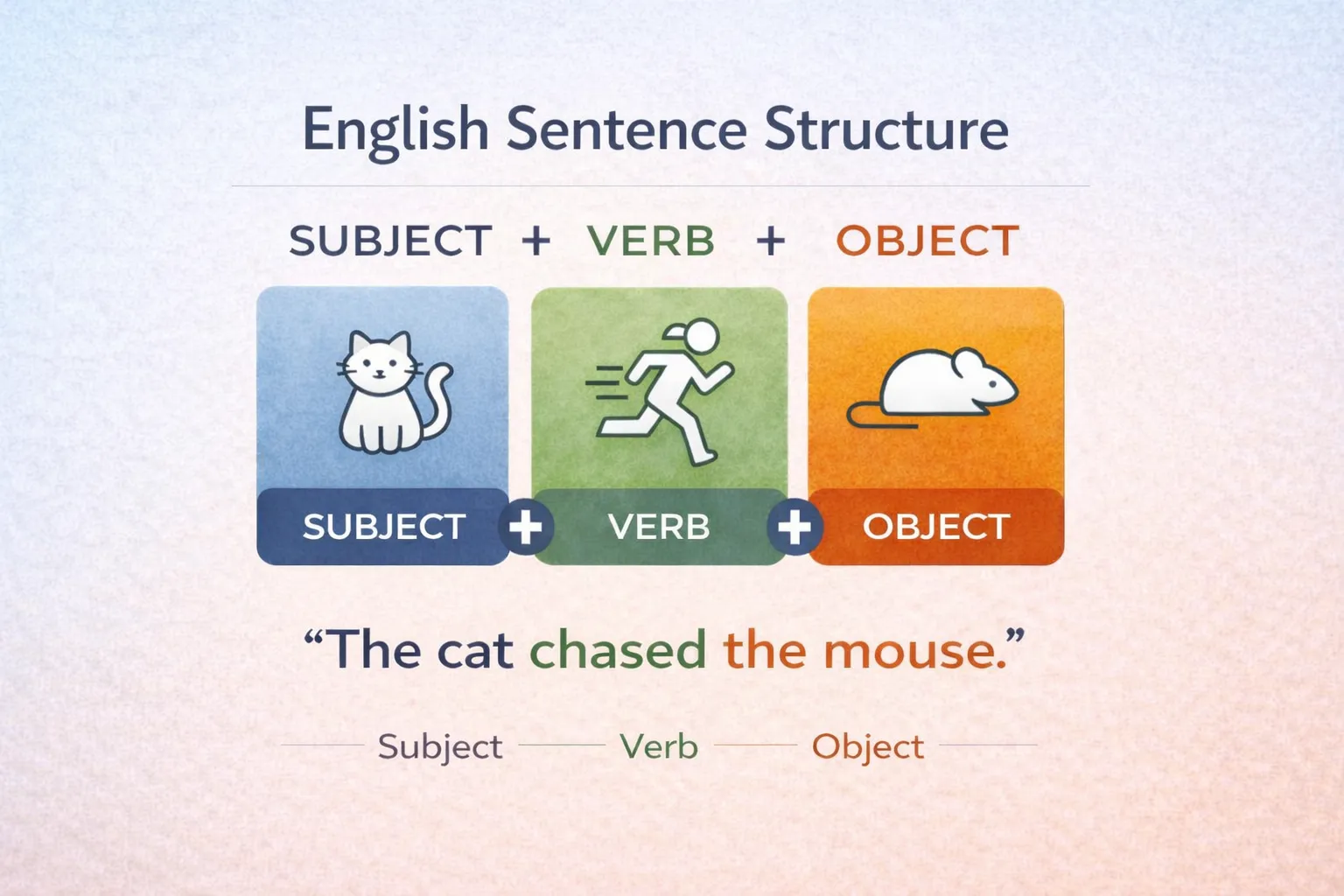
Who — The Subject
Always comes first
The subject is the person or thing doing the action. It always opens the sentence.
"My sister works in a hospital."
"The coffee is too hot."
It can be a name (Kate), a pronoun (she, they, I), or a noun (the dog, my boss). Doesn’t matter — it always goes first.
Does what — The Verb
Right after the subject
The verb tells us what’s happening. It follows the subject immediately — no exceptions.
"She reads every night before bed."
"We work from home on Fridays."
To what / whom — The Object
What receives the action
The object is what the action is done to. It comes after the verb.
"I love this city."
"He sent her a message."
Some sentences don’t need an object at all. “She smiled.” — complete sentence. ✅
Where & When — Extra Details
Always at the end
Place and time details go at the end of the sentence. Never at the beginning.
This morning I had coffee.
I had coffee this morning.
In Boston she works.
She works in Boston.
Last summer we met.
We met last summer.
Making It Negative
To say something didn’t happen, add don’t / doesn’t / didn’t before the verb.
| Who | Add this | Example |
|---|---|---|
| I / You / We / They | don’t | I don’t like mornings. |
| He / She / It | doesn’t | She doesn’t work here. |
| Anyone (past) | didn’t | He didn’t know the answer. |
She don't like spicy food.
She doesn't like spicy food.
I didn't knew the answer.
I didn't know the answer.
Asking Questions
Flip the helper verb to the front:
You like pizza. → Do you like pizza?
She works here. → Does she work here?
"Do you have a minute?"
"Yeah, what's up?"
For longer questions — start with a question word:
| Question | Example answer |
|---|---|
| What do you do? | I’m a nurse. |
| Where does she live? | In Chicago. |
| Why didn’t you call? | Sorry, I was busy. |
| How do you say this? | Like this — listen. |
Words That Describe: Before or After?
Describing words go before the noun:
a cold morning / a funny story / a long day
How-it-happens words go after the verb:
She speaks quietly. / He drives fast. / They laughed loudly.
I very like chocolate.
I really like chocolate.
She plays every day tennis.
She plays tennis every day.
One special case — words like always, never, usually, often:
- Before a regular verb: I always forget my keys.
- After “to be”: She is always late.
A Real Conversation
Notice how every sentence follows the same natural flow:
"What are you doing this weekend?"
"I don't have any plans yet. You?"
"We're going to the lake on Saturday. Do you want to come?"
"That sounds amazing. What time does it start?"
Common Mistakes — Fixed
Yesterday I have seen a great film.
Yesterday I saw a great film.
I am agree with you.
I agree with you.
He is work in a bank.
He works in a bank.
Your Quick Cheat Sheet
[Who] + [Does what] + [To what] + [Where] + [When]

  I       drink       coffee     at home    every morning.
  She     doesn't     like       meetings   on Mondays.
  They    visited     us         in Denver   last spring.
At first you think about the pattern. Then you practice. Then one day — you just speak. That’s how it always works.
Your Turn
Write 3 sentences about your day. Then make one negative and turn one into a question.
Start here:
I woke up at ______. I didn’t ______. Did you ______?
One pattern. Endless possibilities. You’ve got this.