
How to Use the Verb 'To Be' in English: A Simple Guide for Beginners
The verb “to be” is the most used verb in English. It appears in almost every sentence. And the good news? Once you understand it, everything else gets easier.
Let’s break it down — simply, clearly, together.
What Is the Verb “To Be”?
“To be” is a special verb in English. It doesn’t describe an action like run or eat. Instead, it connects a subject to information about that subject.
Think of it like an equals sign (=):
I am tired. → I = tired
She is a teacher. → She = teacher
They are happy. → They = happy
Easy, right? It just tells us what something is, where it is, or how it feels.
The 3 Forms: Am, Is, Are
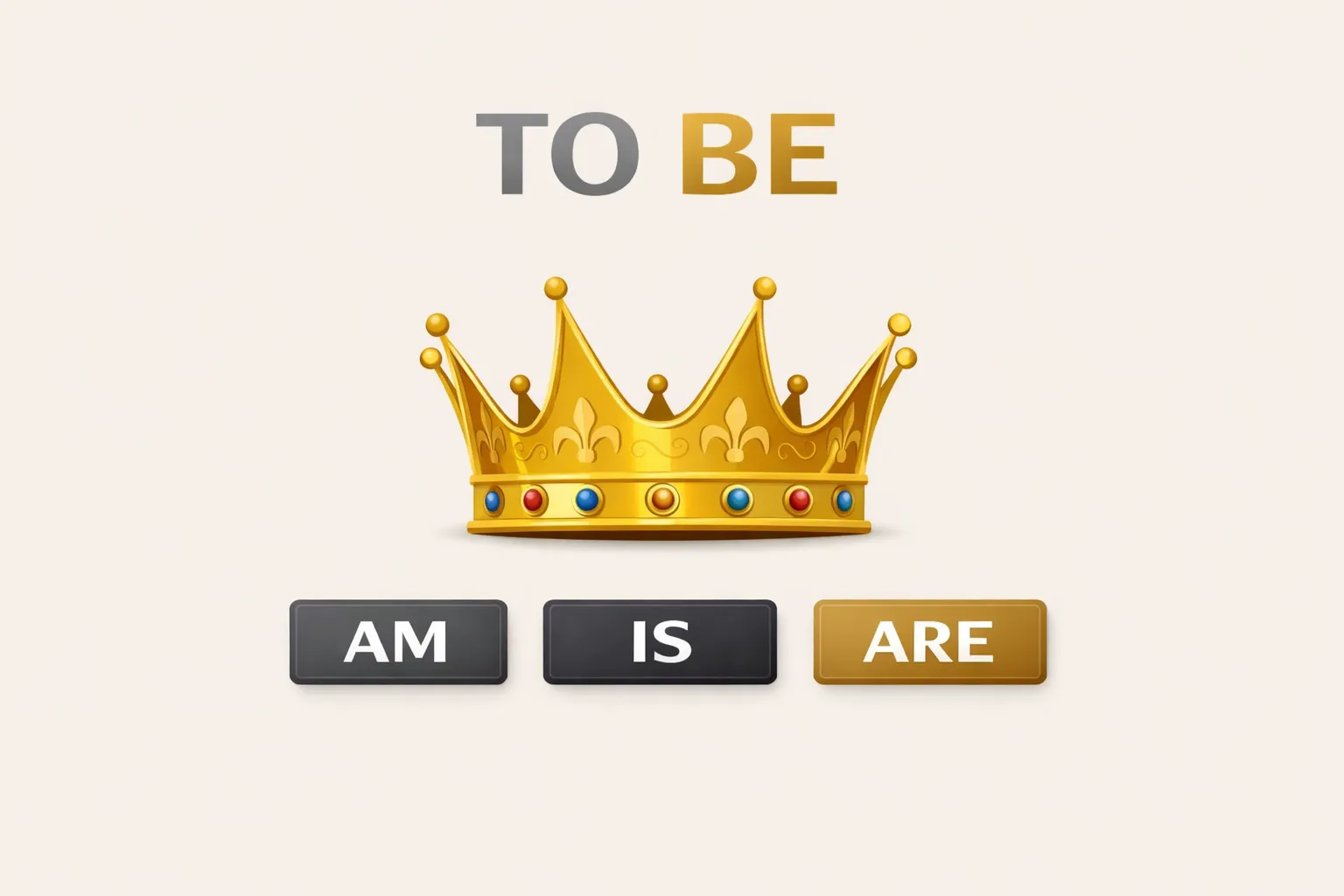
This is the heart of the lesson. In the present tense, “to be” has three forms.
| Pronoun | Verb “To Be” | Example |
|---|---|---|
| I | am | I am a student. |
| You | are | You are kind. |
| He | is | He is tall. |
| She | is | She is from Brazil. |
| It | is | It is cold today. |
| We | are | We are friends. |
| You (plural) | are | You are all welcome. |
| They | are | They are at home. |
A simple trick: I → am. He/She/It → is. Everything else → are. Print it, stick it on your wall, repeat it in the shower.
How to Use “To Be” — 4 Key Situations
Describing People & Things
Who they are
Use “to be” to say what someone or something is like.
"She is very friendly."
"The coffee is hot."
"We are ready!"
Saying Where Something Is
Location
Use “to be” to talk about place or position.
"I am at work right now."
"The keys are on the table."
"She is in London this week."
Talking About Age, Nationality & Jobs
Identity
“To be” is the go-to verb for introducing yourself and others.
"I am 25 years old."
"He is Italian."
"They are doctors."
Talking About Feelings & States
Emotions
Feelings, weather, time — “to be” covers it all.
"I am so tired today."
"It is windy outside."
"Are you okay?"
Short Forms (Contractions)
In everyday English, people almost never say the full form. They use contractions — shorter, faster versions.
| Full Form | Contraction | Example |
|---|---|---|
| I am | I’m | I’m hungry. |
| You are | You’re | You’re amazing. |
| He is | He’s | He’s at school. |
| She is | She’s | She’s my sister. |
| It is | It’s | It’s a beautiful day. |
| We are | We’re | We’re late! |
| They are | They’re | They’re not home. |
Negative Sentences: “Not”
To make a sentence negative, just add not after “to be”.
I am not happy about this.
I'm not happy about this.
| Full Negative | Short Negative | Example |
|---|---|---|
| I am not | I’m not | I’m not ready. |
| You are not | You aren’t / You’re not | You aren’t wrong. |
| He is not | He isn’t / He’s not | He isn’t here. |
| She is not | She isn’t / She’s not | She’s not tired. |
| It is not | It isn’t / It’s not | It isn’t far. |
| We are not | We aren’t / We’re not | We’re not lost. |
| They are not | They aren’t / They’re not | They aren’t coming. |
Questions: Flip It!
To ask a question with “to be”, simply move the verb to the front of the sentence.
Statement: You are happy.
Question: Are you happy?
| Question | Short Answer (Yes) | Short Answer (No) |
|---|---|---|
| Am I late? | Yes, you are. | No, you aren’t. |
| Are you okay? | Yes, I am. | No, I’m not. |
| Is he a doctor? | Yes, he is. | No, he isn’t. |
| Is it raining? | Yes, it is. | No, it isn’t. |
| Are they ready? | Yes, they are. | No, they aren’t. |
Notice: in short answers, we never use a contraction for “Yes”. We say “Yes, I am.” — not “Yes, I**‘m**.” This is a small but important rule!
Past Tense: Was & Were
“To be” also has a past tense. Instead of am/is/are, we use was and were.
| Present | Past | Example |
|---|---|---|
| I am | I was | I was very nervous yesterday. |
| You are | You were | You were great at the meeting! |
| He/She/It is | He/She/It was | She was a teacher for 20 years. |
| We/They are | We/They were | They were so happy together. |
"I was there. It was incredible."
"We were students in the same class."
For negatives in the past: was not (wasn’t) / were not (weren’t)
For questions in the past: flip it again! → Was she there? Were you at the party?
Common Mistakes — And How to Fix Them
These are the errors beginners make most often. Let’s fix them now.
She is 30 years. / He have 30 years.
She is 30 years old.
I am agree with you.
I agree with you.
It is depends on the weather.
It depends on the weather.
They is my friends.
They are my friends.
Real Conversations
Let’s see “to be” in action in everyday situations.
At a café:
"Hi! Is this seat free?"
"Of course, have a seat."
Talking about the weather:
"It is so cold today, isn't it?"
"Absolutely. It is definitely not a day for a walk."
Quick Summary
Here is everything you learned, in one place.
| Tense | I | You / We / They | He / She / It |
|---|---|---|---|
| Present ✅ | am | are | is |
| Past ⏪ | was | were | was |
| Negative (present) ❌ | am not | aren’t | isn’t |
| Negative (past) ❌⏪ | wasn’t | weren’t | wasn’t |
Your Turn
Here’s a starter:
I am ______. My city is ______. My friends are ______.
Don’t wait for perfect. Start with true. That’s how language grows.
You now know the most important verb in English. Everything else — the tenses, the questions, the stories — they all start here. You’re already further than you think.