Present Continuous Tense: Meaning, Rules, and Examples
What is the present continuous?
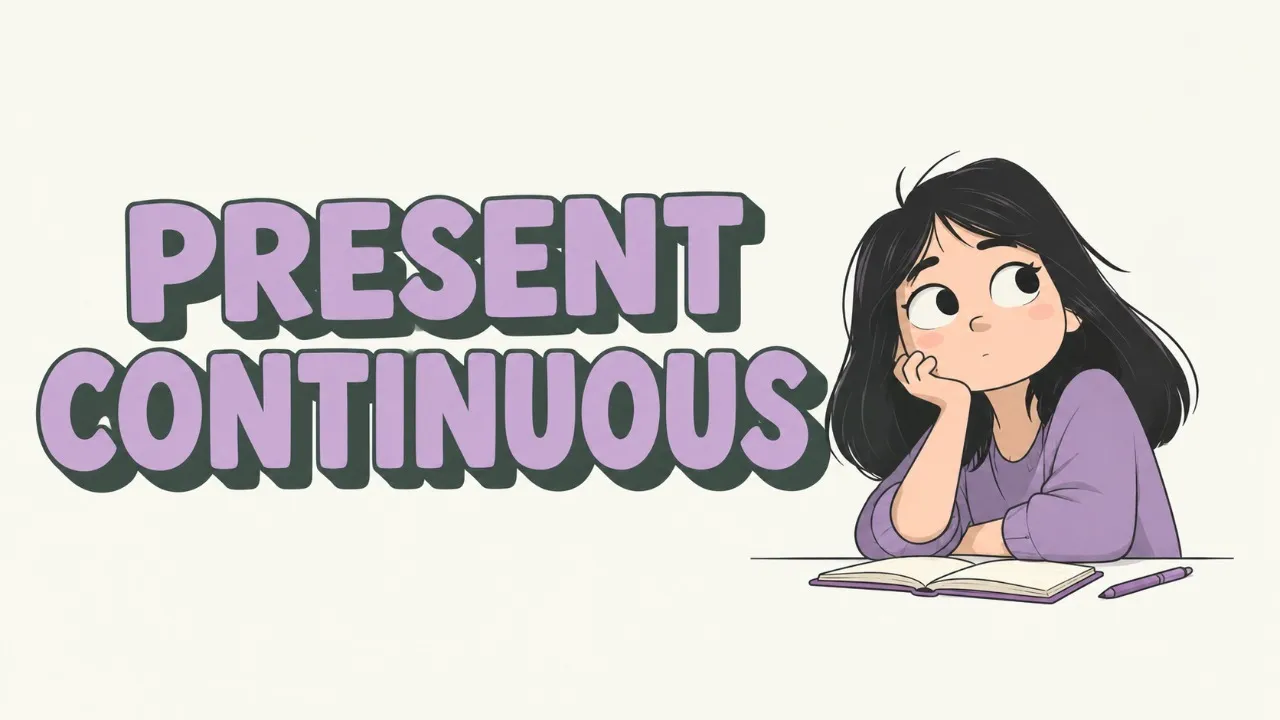
We use the present continuous (also called the present progressive) to talk about things that are happening now, or around now.
We make it with am / is / are + verb-ing. The form is the same for all verbs.
Examples:
- I am writing a book.
- She is listening to the radio.
- They are doing their homework.
Positive
We use the present simple of be (am, is, are) and the -ing form of the verb. In speech and informal writing we usually use the short form.
| Subject | Positive | Short form |
|---|---|---|
| I | I am working | I’m working |
| you | you are working | you’re working |
| he | he is working | he’s working |
| she | she is working | she’s working |
| it | it is working | it’s working |
| we | we are working | we’re working |
| they | they are working | they’re working |
Examples:
- I’m watching TV.
- She’s cooking dinner.
- They’re playing football.
Spelling: the -ing form
| Rule | Verb | -ing form |
|---|---|---|
| Most verbs: add -ing | work | |
| play | ||
| Verbs ending in -e: drop the e | write | |
| make | ||
| Short verbs with one vowel + one consonant: double the consonant | run | |
| sit | ||
| Verbs ending in -ie: change to -ying | lie |
Examples:
- He is writing an email.
- The dog is running in the park.
- We are sitting in the garden.
Negative
To make the negative, we add not after am, is, are. The short forms are I’m not, he isn’t, they aren’t.
Examples:
- I am not writing a book. = I’m not writing a book.
- She is not listening to the radio. = She isn’t listening to the radio.
- They are not doing their homework. = They aren’t doing their homework.
Questions
For a yes / no question, we put am, is or are before the subject.
Examples:
- Are you studying now?
- Is she doing her homework?
- Is it raining?
For a question with a question word (what, why, when, who, how), the question word goes first.
Examples:
- What are you studying now?
- Why is it raining?
- Who are we meeting?
Short answers
In short answers we use be, not the main verb.
Examples:
- Are you writing a book? — Yes, I am. / No, I’m not.
- Is she listening to the radio? — Yes, she is. / No, she isn’t.
We can use a short form in a negative short answer, but not in a positive one. (NOT: Yes, I’m.)
When do we use it?
Actions happening now
We use the present continuous for things that are happening at the moment of speaking.
Examples:
- What are you doing? — I’m watching TV.
- The baby is sleeping. Please be quiet.
Actions happening around now
We also use it for temporary things that are happening these days or weeks, not necessarily at the moment of speaking.
Examples:
- I’m reading a very good book at the moment. (I am not reading it right now, but I’m reading it these days.)
- She’s studying English this year.
Time expressions
These words and phrases often go with the present continuous.
| Use | Examples |
|---|---|
| Now | |
| Around now |
Examples:
- They are working at the moment.
- I’m learning to drive these days.
Verbs we do not use in the present continuous
Some verbs describe a state, not an action. We usually do not use them in the present continuous. We use the present simple.
| State verbs | Examples |
|---|---|
| know · understand | I know the answer. (NOT: |
| like · love · hate | She loves this song. |
| need · belong | We need some help. |
Present simple or present continuous?
| Present simple | Present continuous |
|---|---|
| habits and facts | things happening now or around now |
| She works late on Fridays. | She is working late today. |
| always, usually, every day | now, at the moment, today, these days |
Common mistakes
PRESENT CONTINUOUS (Present Progressive)
Present Continuous
am / is / are + verb-ing — now and around now